
Ojos alienígenas en la Tierra: lo que la visión de los insectos puede enseñar a la astrobiología
DOI:
https://doi.org/10.69976/aspast.v3n1.4Palabras clave:
Visión por computadora, biomímesis, exoplanetas, BiofirmasResumen
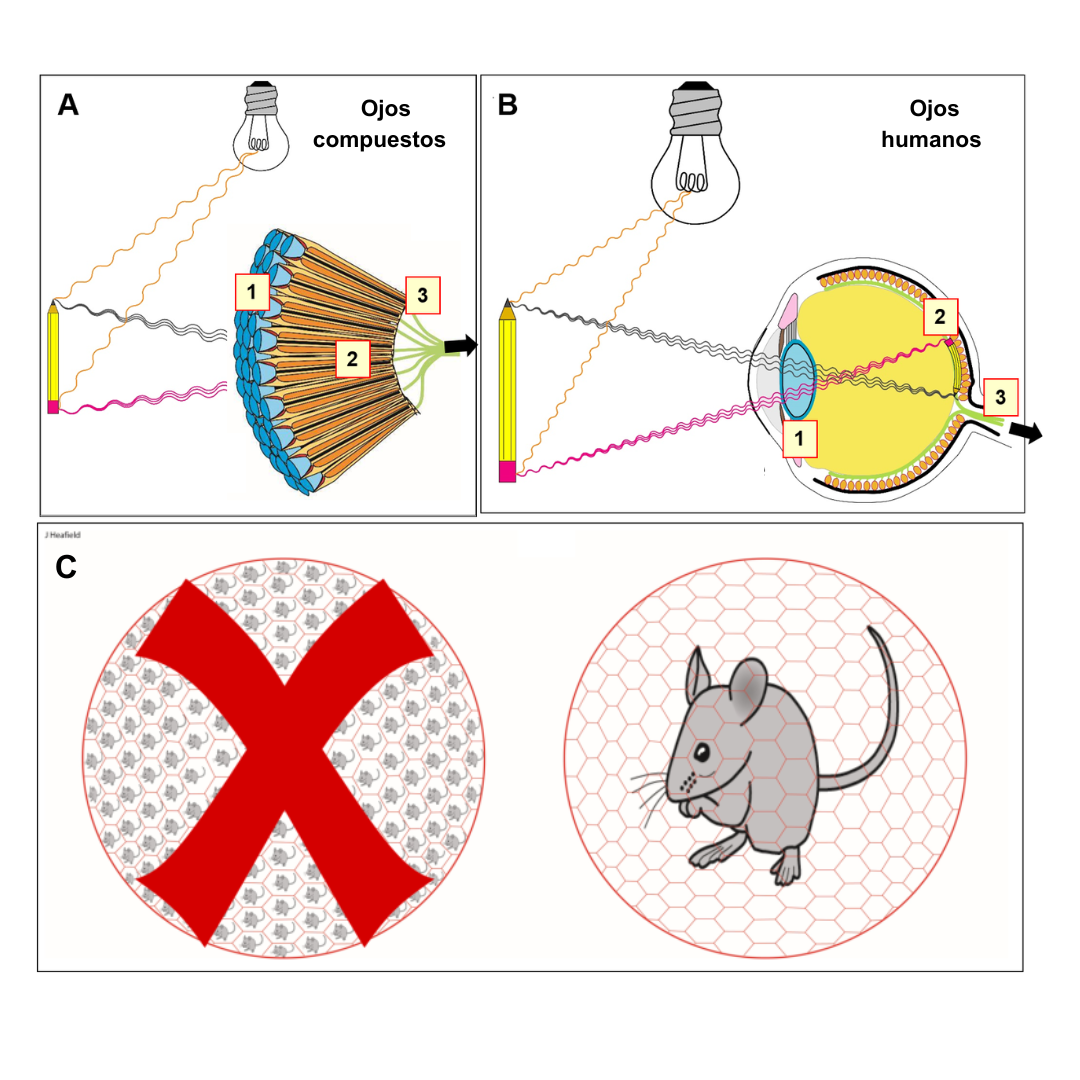
La exploración de exoplanetas presenta desafíos tanto únicos como interesantes para la identificación de biofirmas específicamente en espectros lumínicos que el ojo humano no detecta. Este artículo explora cómo el ojo compuesto de los insectos ofrece un modelo biológico modelable y replicable para la exploración espacial, gracias a los avances en visión por computadora y redes neuronales. La idea es procesar la información proveniente de los espectros de luz ultravioleta y polarizada, para traducirlos en algoritmos de navegación útiles para los rovers. Se propone que la arquitectura visual de los insectos no solo sería una herramienta práctica, sino un marco conceptual para entender cómo formas de vida extraterrestre podrían percibir su entorno bajo diferentes condiciones que afecten el espectro de luz, ya sea radiaciones estelares extremas, atmósferas densas o la oscuridad absoluta.
Descargas
Referencias
Boström, J. E., Dimitrova, M., Canton, C., Håstad, O., Qvarnström, A., & Ödeen, A. (2016). Ultra-Rapid Vision in Birds. PLOS ONE, 11(3), e0151099. https://doi.org/10.1371/JOURNAL.PONE.0151099
Briscoe, A. D., & Chittka, L. (2001). The evolution of color vision in insects. Annual Review of Entomology, 46(Volume 46, 2001), 471–510. https://doi.org/10.1146/ANNUREV.ENTO.46.1.471/CITE/REFWORKS
Catling, D. C., Krissansen-Totton, J., Kiang, N. Y., Crisp, D., Robinson, T. D., Dassarma, S., Rushby, A. J., Del Genio, A., Bains, W., & Domagal-Goldman, S. (2018). Exoplanet Biosignatures: A Framework for Their Assessment. Astrobiology, 18(6), 709–738. https://doi.org/10.1089/AST.2017.1737;REQUESTEDJOURNAL:JOURNAL:ASBA;WGROUP:STRING:PUBLICATION
Chittka, L., & Menzel, R. (1992). The evolutionary adaptation of flower colours and the insect pollinators’ colour vision. Journal of Comparative Physiology A, 171(2), 171–181. https://doi.org/10.1007/BF00188925/METRICS
Ecocolmena. (2016). Cómo ve una abeja Apis mellifera las flores. https://www.ecocolmena.org/flores-como-ve-una-abeja-sus-colores-y-formas/
Cronin, T. W. ., Johnsen, S., Marshall, N. Justin., & Warrant, E. J. . (2014). Visual ecology. Princeton University Press.
Cronin, T. W., & Bok, M. J. (2016). Photoreception and vision in the ultraviolet. Journal of Experimental Biology, 219(18), 2790–2801. https://doi.org/10.1242/JEB.128769
Floreano, D., Pericet-Camara, R., Viollet, S., Ruffier, F., Brückner, A., Leitel, R., Buss, W., Menouni, M., Expert, F., Juston, R., Dobrzynski, M. K., L’Eplattenier, G., Recktenwald, F., Mallot, H. A., & Franceschini, N. (2013). Miniature curved artificial compound eyes. Proceedings of the National Academy of Sciences, 110(23), 9267–9272. https://doi.org/10.1073/PNAS.1219068110
Grimaldi, D. A. ., & Engel, M. S. . (2005). Evolution of the insects. Cambridge University Press.
Haarlem, C. S., Hynes, C., Jackson, A. L., Mitchell, K. J., O’Connell, R. G., & Healy, K. (2026). Pace of ecology drives the tempo of visual perception across the animal kingdom. Nature Ecology & Evolution 2026 10:4, 10(4), 712–720. https://doi.org/10.1038/s41559-026-02994-7
Jing, X., Li, S., Zhu, R., Ning, X., & Lin, J. (2024). Miniature bioinspired artificial compound eyes: microfabrication technologies, photodetection and applications. Frontiers in Bioengineering and Biotechnology, 12, 1342120. https://doi.org/10.3389/FBIOE.2024.1342120/FULL
Joshua Heafield, Charlotte Blackburn, Sanjai Patel, & Andreas Prokop. (2017). LESSON 5 – Vision: Understanding light perception. https://droso4schools.wordpress.com/l5-vision/
Kiang, N. Y., Siefert, J., Govindjee, & Blankenship, R. E. (2007). Spectral signatures of photosynthesis. I. Review of Earth organisms. Astrobiology, 7(1), 222–251. https://doi.org/10.1089/AST.2006.0105;SUBPAGE:STRING:ABSTRACT;JOURNAL:JOURNAL:ASBA;WEBSITE:WEBSITE:SAGE;ISSUE:ISSUE:DOI
Krissansen-Totton, J., Bergsman, D. S., & Catling, D. C. (2016). On Detecting Biospheres from Chemical Thermodynamic Disequilibrium in Planetary Atmospheres. Astrobiology, 16(1), 39–67. https://doi.org/10.1089/AST.2015.1327;JOURNAL:JOURNAL:ASBA;WEBSITE:WEBSITE:SAGE;REQUESTEDJOURNAL:JOURNAL:ASBA;WGROUP:STRING:PUBLICATION
Land, M. F., & Nilsson, D.-E. (2012). Animal Eyes. Animal Eyes. https://doi.org/10.1093/ACPROF:OSO/9780199581139.001.0001
Li, S., Kong, F., Xu, H., Guo, X., Li, H., Ruan, Y., Cao, S., & Guo, Y. (2023). Biomimetic Polarized Light Navigation Sensor: A Review. Sensors 2023, Vol. 23, Page 5848, 23(13), 5848. https://doi.org/10.3390/S23135848
Lovelock, J. E. (1965). A Physical Basis for Life Detection Experiments. Nature 1965 207:4997, 207(4997), 568–570. https://doi.org/10.1038/207568a0
McElwain, M. W., Feinberg, L. D., Perrin, M. D., Clampin, M., Mountain, C. M., Lallo, M. D., Lajoie, C.-P., Kimble, R. A., Bowers, C. W., Stark, C. C., Acton, D. S., Aiello, K., Atkinson, C., Barinek, B., Barto, A., Basinger, S., Beck, T., Bergkoetter, M. D., Bluth, M., … Zielinski, T. P. (2023). The James Webb Space Telescope Mission: Optical Telescope Element Design, Development, and Performance. Publications of the Astronomical Society of the Pacific, 135(1047), 2023. https://doi.org/10.1088/1538-3873/acada0
OpenAI. (2026). ChatGPT (versión GPT-5.2, con extensión de imágenes ChatGPT Imágenes 2.0) [Modelo de lenguaje de gran escala con generación de imágenes]. https://chatgpt.com/
Schwieterman, E. W., Kiang, N. Y., Parenteau, M. N., Harman, C. E., Dassarma, S., Fisher, T. M., Arney, G. N., Hartnett, H. E., Reinhard, C. T., Olson, S. L., Meadows, V. S., Cockell, C. S., Walker, S. I., Grenfell, J. L., Hegde, S., Rugheimer, S., Hu, R., & Lyons, T. W. (2018). Exoplanet Biosignatures: A Review of Remotely Detectable Signs of Life. Astrobiology, 18(6), 663–708. https://doi.org/10.1089/AST.2017.1729;WEBSITE:WEBSITE:SAGE;ISSUE:ISSUE:DOI
Seager, S. (2014). The future of spectroscopic life detection on exoplanets. Proceedings of the National Academy of Sciences of the United States of America, 111(35), 12634–12640. https://doi.org/10.1073/PNAS.1304213111
Seager, S., Turner, E. L., Schafer, J., & Ford, E. B. (2005). Vegetation’s red edge: A possible spectroscopic biosignature of extraterrestrial plants. Astrobiology, 5(3), 372–390. https://doi.org/10.1089/AST.2005.5.372
Trees, V. J. H., & Stam, D. M. (2022). Ocean signatures in the total flux and polarization spectra of Earth-like exoplanets. Astronomy & Astrophysics, 664, A172. https://doi.org/10.1051/0004-6361/202243591
Tyo, J. S., Goldstein, D. L., Chenault, D. B., & Shaw, J. A. (2006). Review of passive imaging polarimetry for remote sensing applications. Applied Optics, Vol. 45, Issue 22, Pp. 5453-5469, 45(22), 5453–5469. https://doi.org/10.1364/AO.45.005453
Viollet, S., Godiot, S., Leitel, R., Buss, W., Breugnon, P., Menouni, M., Juston, R., Expert, F., Colonnier, F., L’Eplattenier, G., Brückner, A., Kraz, F., Mallot, H., Franceschini, N., Pericet-Camara, R., Ruffier, F., & Floreano, D. (2014). Hardware Architecture and Cutting-Edge Assembly Process of a Tiny Curved Compound Eye. Sensors 2014, Vol. 14, Pages 21702-21721, 14(11), 21702–21721. https://doi.org/10.3390/S141121702
Webb, B., & Wystrach, A. (2016). Neural mechanisms of insect navigation. Current Opinion in Insect Science, 15, 27–39. https://doi.org/10.1016/J.COIS.2016.02.011
Wehner, R. (2003). Desert ant navigation: how miniature brains solve complex tasks. Journal of Comparative Physiology A 2003 189:8, 189(8), 579–588. https://doi.org/10.1007/S00359-003-0431-1
Yang, S. X., Li, J., Chen, G., Lei, X., Li, S., Lodewijks, G., Zhang, R., & Zou, M. (2026). Bioinspired Design for Space Robots: Enhancing Exploration Capability and Intelligence. Biomimetics 2026, Vol. 11, Page 30, 11(1), 30. https://doi.org/10.3390/BIOMIMETICS11010030
Zugger, M. E., Kasting, J. F., Williams, D. M., Kane, T. J., & Philbrick, C. R. (2010). LIGHT SCATTERING FROM EXOPLANET OCEANS AND ATMOSPHERES. The Astrophysical Journal, 723(2), 1168. https://doi.org/10.1088/0004-637X/723/2/1168
Publicado
Número
Sección
Categorías
Licencia
Derechos de autor 2026 Nicolas Ayala-Tovar (Autor/a)

Esta obra está bajo una licencia internacional Creative Commons Atribución 4.0.


